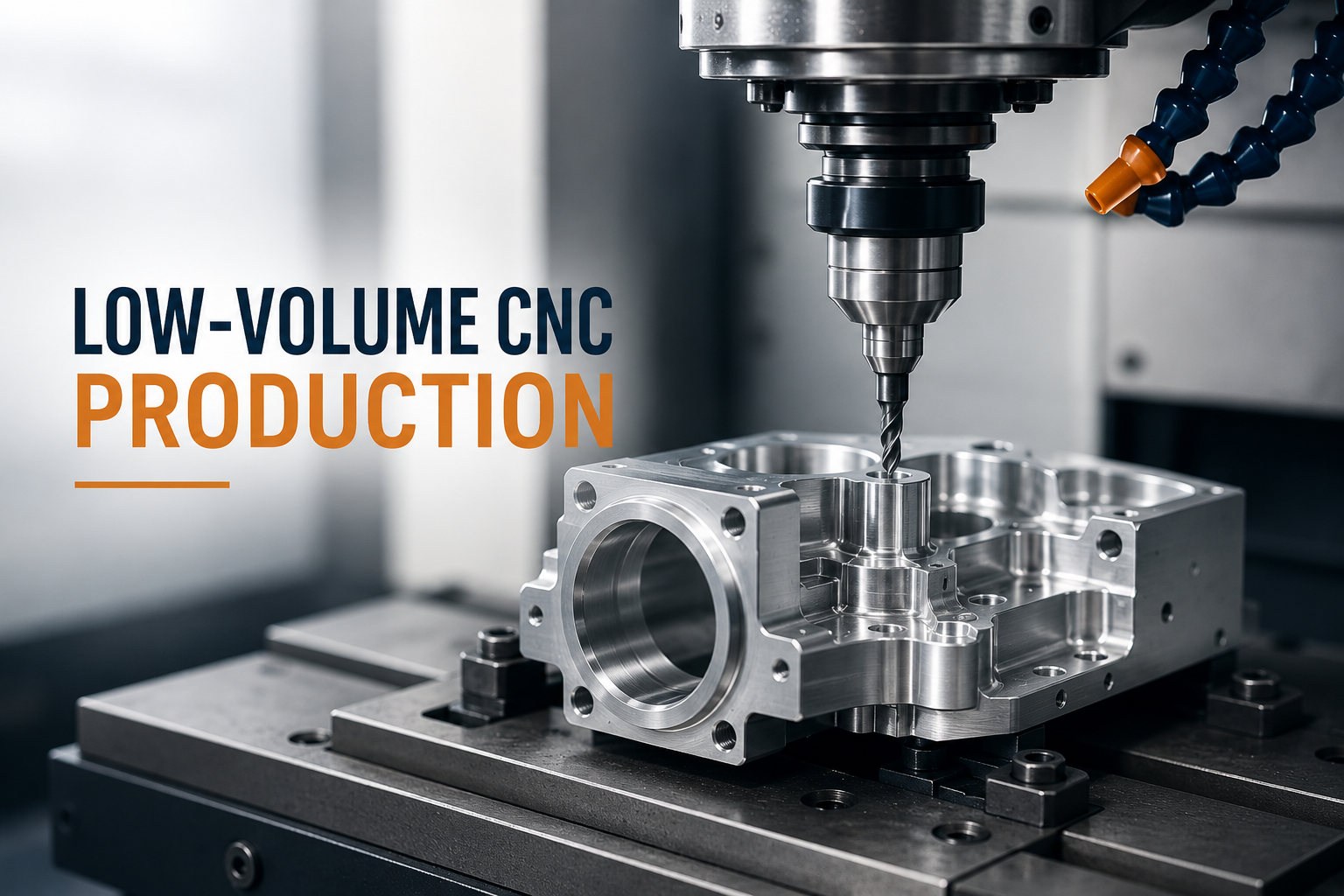

Product teams often face an awkward gap between a successful prototype and the moment when dedicated production tooling makes economic sense. Low-volume CNC machining can fill that gap by producing end-use or near-production parts directly from digital models without committing to a mold or die. CSMolding positions its machining services for prototypes and low-volume production, making the process relevant to pilot builds, early customer shipments, validation fleets, and temporary supply-chain coverage.

Bridge Production Buys Information
Early demand forecasts are rarely perfect. Producing dozens or hundreds of machined parts can let a company observe real field use before freezing a design for higher-volume tooling. If a mounting boss needs to move or a connector changes, the CAD and machining program can be revised without discarding a hard tool.
This flexibility has a value beyond per-part price. It can reduce the cost of being wrong. Teams can validate assembly time, packaging, service access, surface finishes, and customer behavior with hardware that is much closer to the intended product than a visual mockup.
Repetition Still Deserves Production Thinking
Low volume is not an excuse for loose process control. Once a prototype becomes a recurring part, look for stable datums, reliable workholding, standardized tools, and inspection checkpoints. Small design changes that simplify fixturing can matter more over 100 parts than they did for a single prototype.
Batch size should also influence the drawing. Identify truly critical characteristics and avoid unnecessarily tight limits on every feature. Consistent, measurable requirements make it easier to detect process drift without drowning the inspection plan in low-value measurements.
Know When to Change the Manufacturing Route
Machining can remain economical for complex, low-volume components for a long time, especially when the material is purchased as stock and geometry changes occasionally. As demand climbs, however, casting, molding, stamping, extrusion, or dedicated fixtures may lower unit cost.
The transition point depends on geometry, material, tooling investment, forecast confidence, and the cost of design changes. Rather than treating prototype and production as separate worlds, use bridge manufacturing as a learning phase. The best outcome is not simply “parts quickly”; it is a controlled path that lets the design mature, the market become clearer, and the eventual high-volume process begin with fewer expensive surprises.